Showing posts with label Spanish. Show all posts

Wednesday, August 6, 2014

Time: Better Late With a Treasure?

By Sarah Fiske
InteRDom Correspondent, Sarah, has recently completed her undergraduate studies in Political Science at the University of Louisville, Kentucky. She is participating in the 2014 10-week InteRDom Summer Program. You can read more about Sarah and her participation in the Correspondent Program here.

It’s almost time for me to go back home, and unlike with many things here, that can’t happen late.

I got an email kindly reminding me I was due (overdue) for writing a blog post and my first thought was, “let me see how quickly I can write this thing.” It is crunch time in my second internship - a research project on CAFTA-DR (DR, Central American, US Free Trade Agreement), and I feel like I am just getting my footing on it. I chuckled at my thought because I’m never able to write these things quickly, but also because here [in the DR] things just don’t happen quickly. It’s a cultural thing and I’m catching the bug. So, I thought I’d write a little post about time.

In the last blog I talked about culture and stereotypes, and emphasized underlying similarities. Keeping within that framework, I do want to talk about one difference. Let me also add: I know I am talking in generalities. I know these aren’t true for everyone. I don’t mean this to be offensive towards either culture, but to be a critical thinking exercise about culture and stereotypes, and our tendencies to be either blindly close-minded or blindly open-minded. That being said, everyone knows the stereotypes about Latin Americans and time. On time is 10 minutes late, at least - and it is mostly true. It is also often considered a negative side of Latin culture, and for this blog and my experience, specifically Dominican culture.

I can get caught in this fast-paced New England mindset sometimes where everything is go, go, go. Before I finish one thing I am already planning on how I’ll get to the next thing; at home [in Rhode Island] I often pack a day more full than my average week here in DR. I don’t hesitate to eat on the go, and sometimes run from one place to another. Here, things don’t work like that. In fact, I rarely see anyone seemingly in a hurry, except maybe to the corner store ("colmado") to grab an item while cooking. People stop and chat from place to place, and I’ve sat behind so many non-aggressive drivers allowing cars to cut them off through multiple light cycles (though they are quick to honk at a green light). Obviously there are exceptions, but overall the pace of life is just slower here.

Honestly, it can drive me crazy, but frustration doesn’t solve any problems so I choose to just accept it. That’s one step in the right direction, but I can go further. Rather than simply not being bothered by the different flow of time here, I need to learn how to appreciate it. Cultures evolve for reasons. Dominicans weren’t thrown into this cultural view of time and said “these are the rules, do your best.” No, these norms evolved based on the ideals, values and interests of the people in the nation. So, what were these values? What interests does it serve?

There are many answers to that question – and this is an oversimplification of one key factor, but I think it has key truth.

To answer this, I thought about what a successful day for me would look like in the stereotypical cultural frameworks. In the US cultural mindset I might say, “I hurried to work this morning so I could manage to squeeze in a short lunch date. After work I went to a class at the gym where in 30 minutes I sweat more than most people in a week (thanks Crossfit, for your short, but killer workouts) and, even with a grocery run, I made it home with enough time to change, toss a load of laundry in to the wash, and grab my crock pot dinner to eat in the car on the way to my church group.” My successful day is action packed, a little rushed and schedule-oriented, but accomplishes tangible objectives.

A stereotypical successful day for me in the Dominican cultural framework might look a little different. I might say, “I got off to a slower start at work because my coworker was having some difficult situations at home; we got to talking and I offered her some advice and encouragement. Later, I had some extra time for lunch and enjoyed a big meal with my coworkers. After work I stopped in to visit my aunt and she made me fresh fruit juice and a small soup for dinner; two hours later I left with mangos for my mom and plantains for me. I finished the day meeting a few friends for a jog in the park.” My ideal day is relationship oriented and has enough room to allow time to flow more freely, but has little I can check off the to-do list.
If you search google images for "businessman running" you'll find countless images, clip arts, vector images etc. It's prolific. And you see it in the US. Check out any downtown on a weekday and you'll see men and women glancing at their watches as they run or power walk from one meeting to the next. Here, you don't often see that. Photo: Iain Gillespie, Sydney Morning Herald
Two guys playing dominos - a common pass time here. There is a lot more just spending time with people. Photo from World Race Blog
So, back to the question: how does Dominican culture, relating to time, serve the Dominican people? How is this pace good? How do I appreciate it? Simple, this view on time allows people to build deep relationships with their friends, coworkers and family. The flexibility with time often says you are more important than my next plan – or than me making a next plan. This aspect of Dominican culture is a treasure. When I navigate this culture with this mindset I can still be critical in my view on time, but recognize the treasure that is the other side of the coin.

So what is the take home? We live in an increasingly globalized world; one where many countries, especially developing countries, are criticized for certain aspects of their culture like time. I’ve met a lot of Dominicans who talk about this negative side of their culture but not about where it comes from. My message is: Know the nature of the problem. Dominicans, treasure your culture and the way people are cared for. Understand that is a big factor in the time “problem”. Be critical, but think critically both of others and yourself. I don’t encourage stagnancy, but don’t throw the baby out with the bathwater. You can’t have it all; what do you want as your treasure?

Lastly, your challenge: Do the same thing for US culture. Select a “negative” and see what the complimentary positives or treasures are. I’d do it, but this blog post is probably already past our short, instant gratification period aka: American culture’s current attention span, hint hint ;).

And lastly just for fun a few of my pictures:
"Stand up" paddle boarding (the waves made the stand up part harder) in Cabarete
The Presidential Palace in Santo Domingo with storm clouds in the background
Mate - an Argentine tea tradition - in the park with other interns

Monday, June 30, 2014

Dominican Nom Noms!

By Sarah Fiske
InteRDom Correspondent, Sarah, has recently completed her undergraduate studies in Political Science at the University of Louisville, Kentucky. She is participating in the 2014 10-week InteRDom Summer Program. You can read more about Sarah and her participation in the Correspondent Program here.

Memory is a funny thing. Sometimes it seems the most unusual thing triggers a long buried memory.

For me, the trigger was trying to describe the fruit here. And, the memory was a children’s book: The Little Mouse, The Red Ripe Strawberry and the Big Hungry Bear. I think the title sufficiently tells the plot, but what I remembered is in this story; the Big Hungry Bear smells this strawberry from miles away.

I believe this story is actually an allegory. The authors were clearly relaying their experience with Caribbean fruit! The bear is the gringo, the strawberry is pineapple, passion fruit or mango and the great lengths the bear goes to steal the strawberry and the great lengths the mouse goes to protect it are symbolize just how good the fruit is.

In Spanish I’ve discovered they use a variety of words to describe eating or tasting their food: “Saborear”, “degustar”, “probar”, “catar” and “paladear” are just five and they all translate to “to taste” or “savor” in English, but in Spanish they are more subtle. And, here, more words are useful because there are more flavors to taste. Here I’ll share a little about my food experience here.

I’m staying with a lady who as far as I can tell is the best cook on the island. She also happens to be my boyfriend’s mother… which means I really have to work to impress him with my cooking skills.

Speaking of impressive cooking skills, here is a little anecdote of my first try at cooking on my own here:

Shortly after I arrived here, I wanted to cook something for dinner – try and carry a little of my weight (and maybe try and make a good impression on the BF’s family too). Of course Dominicans are known for their great hospitality so it took some convincing to let the guest do work in the kitchen. I was going to make a wild rice, salad and bake some chicken… and I was going to show them that I could cook!

You know that pride cometh before the fall.

I put the chicken in the toaster oven at 350 for about 25min, just like I would at home. When the timer went off I took it out and cut into a piece of chicken: cooked but still juicy. Perfect, I thought. I’ll show them some good, healthy American cooking (since we aren’t exactly known for our healthy eating in the US). Everything was ready so I set the table and we ate.

And we cut into the chicken… and it was juicy, and it wasn’t overcooked. But the juice was a little on the red side and it was undercooked!

Thankfully and not surprisingly, my boyfriend’s family was kind to me. And since then I have gotten cooking lessons from his mom, whom like I said, as far as I can tell, is the best cook on the island.

Here are a few pictures of traditional Dominican food I’ve been having here:

Life’s short so let’s start with dessert:
“Majarete”, a sweet but not too sweet corn pudding. It is good! Again, photo is compliments of my favorite food blog: dominicancooking.com.


In the DR they have a huge variety of starchy vegetables. Here are a few:

"Yuca" here. I really like it plain boiled with some onions on top.


This is fried plantain, "tostones', a bit healthier than fries anyway. Plantain is common here and can be eaten fried like this, baked, boiled, pureed, etc.


And here is a DR sweet potato: Unfortunately the picture isn’t from my favorite food blog so it isn’t quite as good…


So there you have it: a little picture of some Dominican food. Take a look at Dominicancooking.com for some great pictures and recipes. And stay tuned! Next time I promise I’ll post my own pictures.

Memory is a funny thing. Sometimes it seems the most unusual thing triggers a long buried memory.


Thursday, June 19, 2014

Running


By: Sarah Fiske
InteRDom Correspondent, Sarah, has recently completed her undergraduate studies in Political Science at the University of Louisville, Kentucky. She is participating in the 2014 10-week InteRDom Summer Program. You can read more about Sarah and her participation in the Correspondent Program here.

I seem to be encountering a lot of running here. Today it was running to work after I took the wrong share taxi! Sometimes it is a few miles in the park, but what I want to talk about is metaphorical.  

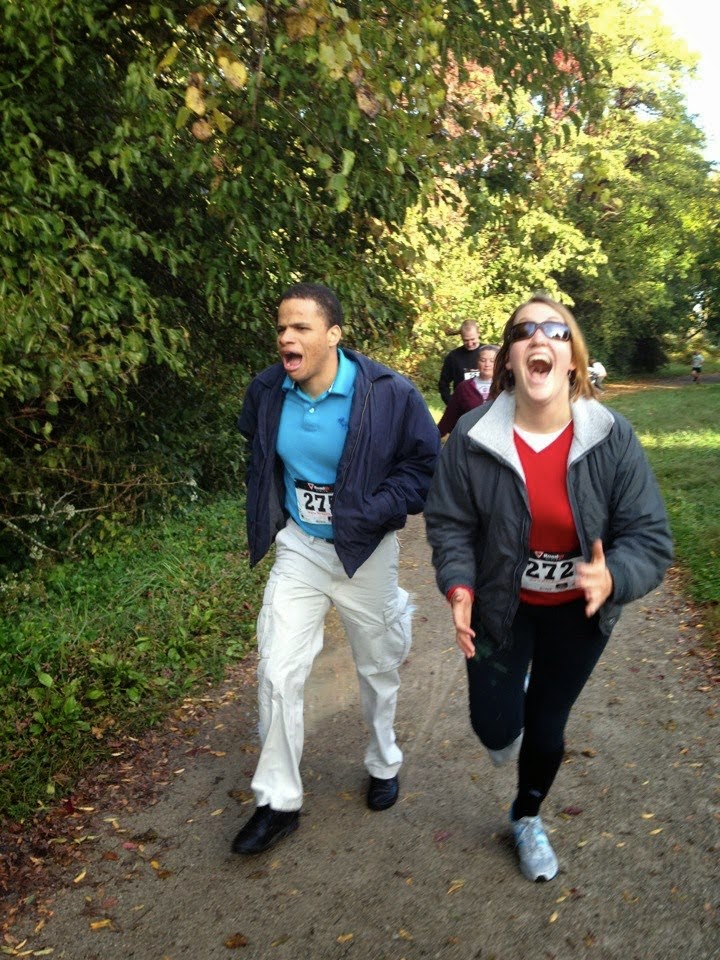
Let me explain: I am not a runner.  I can run, but it isn’t pretty and it doesn’t feel pretty (see the picture below from a 5k I ran/walked).  But, running makes the perfect analogy for speaking a foreign language. In my race, the first few miles weren’t too bad. But, it grew harder until eventually I felt like I was inhaling fire and pushing my legs through daggers. It took every ounce of self discipline (or insanity) I could muster to keep going.  I finished, but I was spent. Much like a car sputtering out of gas, my quads kept misfiring causing my knees to buckle as I stumbled to the car.  I was dehydrated, disoriented and dizzy.  All of this, I expected as I hadn’t trained to run this race.  I was a D1 rower, but had been off from an injury for a while so I had some physical stamina, but mostly just mental toughness that I knew would get me through.

Now, speaking Spanish every day feels like this run. I’ve been here two weeks and been at work for 4 days. Every day I start fresh and energized (for the most part) but every day I know the miles of trying to catch the right car to work, read the technical WTO trade policy reports, listen in on meetings, understand the quick-speaking lady I’m staying with, and just live day to day stretch before me like that long road on my 10 mile race.  But, I also know that with each passing mile, I get stronger.  I may feel weaker in the moment, but as days and weeks pass the Spanish becomes easier, just like the running.

And, like my 10 mile race, which was along beautiful ocean side bluffs in Rhode Island, the setting for my daily runs is beautiful.  Each day I am encountering wonderful people, places and experiences.  Let me finish with a story of two juxtaposing events that show the challenges and beauty of being here. Just the other day, I was tired from a long day and a long walk in heels, and I was leaving a meeting early to head home. I had a few minutes to kill since no one was there.  I stopped to get a bottle of water in a little restaurant on the way and thought I’d sit in the park and drink it.  I walked in and it was a little chaotic in the place.  There were a lot of people, no power, and the employees were running around trying to get the generator going.  Someone shouted something to me quickly from across the noisy room that I didn’t understand.  I asked her to repeat herself, but she decided I didn’t speak Spanish and promised to find me an English speaking employee. In Spanish, I insisted it was fine; I just wanted water.  She wasn’t convinced and found a guy to help me. I told him I wanted water, and he kept asking me “Alaska?”  Little did I know, “Alaska” is a brand of water here; you can probably see how that got confusing fast.  

I left with my bottle of water and headed out.  I was tired and a bit discouraged by my language struggle there.  It was humid outside and so I thought I’d take a peek into the National Library (Biblioteca Nacional Pedro Henríquez Ureña) instead of sitting in the park.  I had in mind to go in and see what it was and head back out.  The library employees had something else in mind.  They offered me a tour and a kind and knowledgeable woman came, introduced herself and gave me a tour.  The library was cool and quiet and she spoke slowly and clearly about the history of the building as well as their plans for the future.  She introduced me to the library director who had been to Rhode Island and we had a great talk about RI, authors, economic development, culture, food, etc. I was able to talk with them no problem in Spanish and they even encouraged me by telling me my accent was good and I spoke well.  It was like a wonderful cool downhill at the end of my Spanish run that day.  I exchanged contact information and was invited to come over any time and say hello and have coffee.  I left with a smile, a list of good local establishments and cultural sites to visit and a place I know I can come back to and enjoy a peaceful place to work or a good conversation.

If I’ve learned one thing here, it is that it is the little things that count.  It was a little thing that had me discouraged that day, and a little thing that encouraged me and really made my day.

I’m enjoying this run. I am staying with a wonderful family in a beautiful setting. I am taking in the vivid sounds and sights, appreciating the challenges and taking advantage of the downhill stretches.  

Stay tuned and maybe next time I’ll tell you about my DR birthday, kittens and the fruit you can smell a mile away.

For teasers, here’s a haiku:

Caribbean Fruit

Taste the bright vivid colors

My mouth can’t forget 
Had some fun taking some goofy pictures when walking 5k.
The National Library opened in 1971 and in 1989 they added the public library as well. The beautiful marble building was recently renovated.
Here you can see the newly renovated work stations in progress. The inside still looks like this; it is operating provisionally in small rooms on the first floor while the rest of the building is being finished.  It is bright, cool and peaceful inside and from the upper levels you can see the ocean.